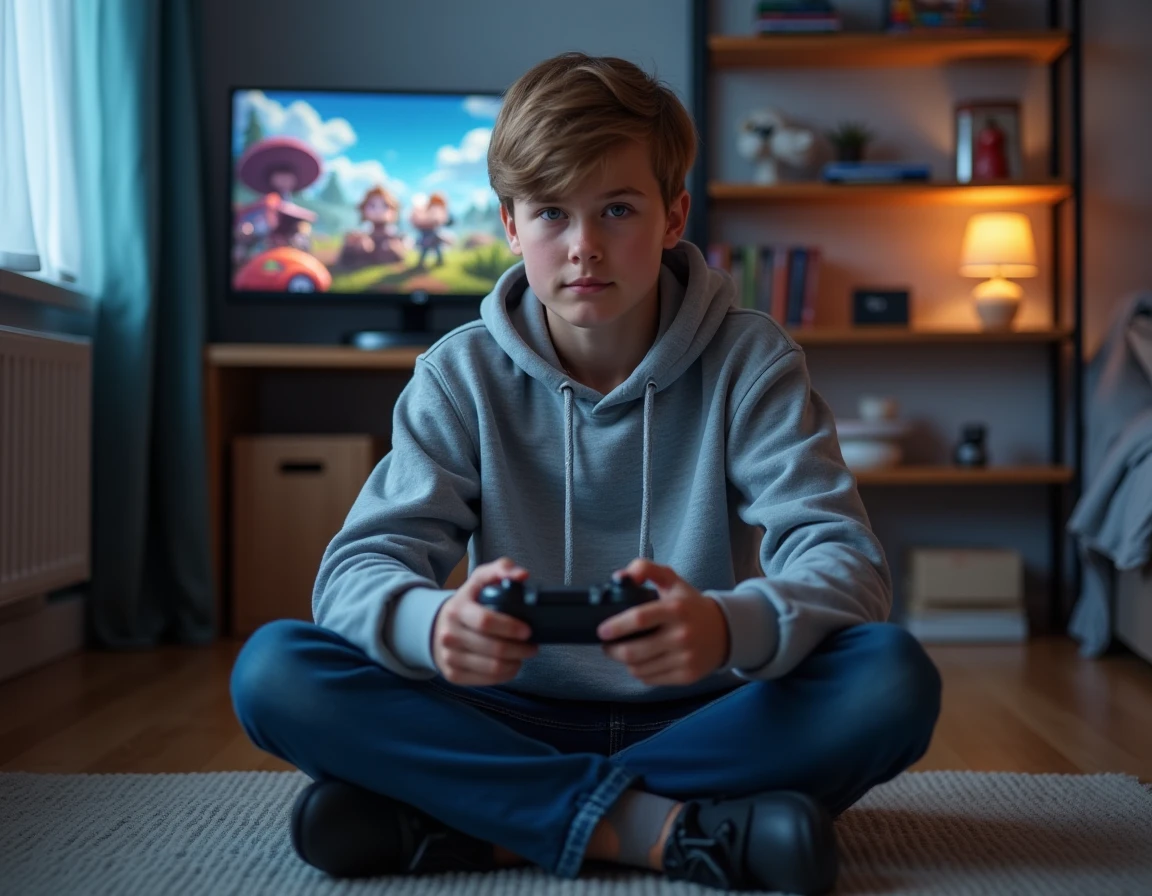
The toy aisles and digital catalogs are looking less and less alike from year to year. On the video game side, recent releases blur the line between children’s titles and experiences designed for adults. In terms of physical toys and board games, the rise of educational ranges and intergenerational formats is reshaping what families and solo players are looking for. Here are the video game and toy trends that deserve your attention.
Intergenerational Board Games: The Rising Niche
Have you ever noticed that a card game bought for your children often ends up captivating the whole table? This phenomenon has a name in the industry: the “kids-friendly but adults-compatible” positioning. Publishers are designing games accessible from ages 8-10, but with strategic depth that also engages parents.
Star Realms Academy exemplifies this approach well. It is an adaptation of a deck-building game popular among adult players, rethought so that children can join in without frustration. The rules remain simple, but the tactical choices keep experienced players engaged. This type of product stands out from classic children’s board games, where adults get bored after two rounds.
To explore a wide catalog of board games, video games, and toys suitable for all ages, a useful resource is: https://www.u-games.ch/, which brings together ranges from educational toys to family card games.
The trend is not limited to card games. Cooperative games, where all players face a game mechanism together rather than competing against each other, appeal to families. Cooperation reduces conflicts between children of different ages and allows parents to guide without dominating the game.

Educational and STEM Toys: Much More Than Just Programming for Kids
The market for educational toys focused on science, technology, engineering, and mathematics (often grouped under the term STEM) is experiencing marked growth. What has changed recently is the target audience. These toys are no longer aimed solely at children: robotics or creative electronics kits are also attracting curious adults.
What Distinguishes a Good STEM Toy from a Gadget
A programmable robot costing 30 euros that ends up in a closet after two weeks is not educational. Successful products share a few common traits:
- They offer a tiered progression, with increasingly challenging tasks that maintain motivation over several weeks.
- They allow for real creativity: the child (or adult) builds, modifies, experiments, rather than following a fixed script.
- They produce a tangible result, an object that moves, a circuit that lights up, a program that runs, which anchors learning in the concrete.
A successful STEM toy combines learning and immediate satisfaction. Kits that require hours of assembly before yielding any results discourage most children, and quite a few adults as well.
Nintendo Switch Video Game Trends: Why the Console Remains at the Center of Family Gaming
Among consoles, the Nintendo Switch holds a special place for family gaming. Its catalog of games accessible to children while still enjoyable for adults remains the most extensive. Mario Kart, Lego games, and recent Pokémon titles share a characteristic: simple mechanics that are easy to grasp but deep enough to last.
The Trap of In-Game Purchases in Children’s Games
Are you looking for a video game for an 8-year-old? The price displayed on the box or the store doesn’t tell the whole story. Many free or inexpensive titles on console and mobile include microtransactions: skins, characters, additional levels. These purchases, often presented as random rewards, exploit psychological mechanisms similar to those of gambling.
Checking for in-game purchases before gifting a game avoids many surprises. PEGI descriptors (the European classification system) now mention this type of content. A game rated PEGI 7 can very well contain purchase incentives that parents may not suspect.

Video Game Disorder: What the WHO Classification Changes Practically
The World Health Organization has included “gaming disorder” in its International Classification of Diseases. This official recognition, effective since 2019, has practical consequences beyond medical diagnosis.
Insurers and educational institutions rely on this classification to structure their prevention actions. For example, MAE offers specific guides for parents on managing gaming time. The topic is no longer confined to parenting forums: it is entering health prevention policies.
Should video games be banned for children? Research on the subject points more towards guidance than prohibition. A clear framework on gaming hours and types of games reduces risks much more effectively than a total ban, which tends to make video gaming even more attractive due to the thrill of transgression.
Three Practical Guidelines for Managing Video Game Time
- Set visible gaming slots (timer, alarm) rather than a vague “not too long,” which provides a concrete reference for the child.
- Alternate solo games and family games: shared play allows for observing the child’s behavior and discussing the content.
- Consult PEGI descriptors and parental reviews on each title before purchase, including for mobile games often perceived as harmless.
The market for video games and toys is evolving towards products that no longer clearly segment children and adults. Intergenerational board games, dual-target STEM toys, and consoles like the Nintendo Switch promote shared gaming moments. The true criterion for choice remains the quality of the shared experience, not the age printed on the box.