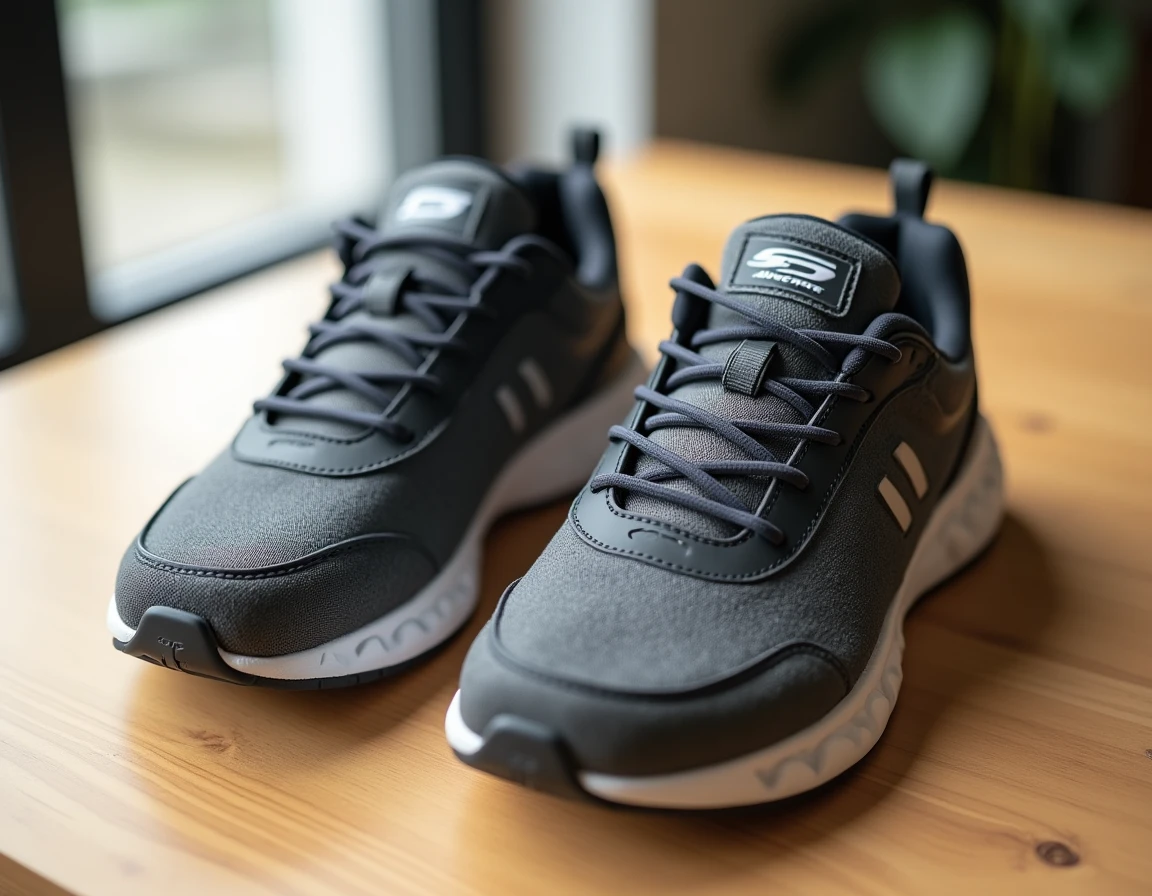
Distinguishing an authentic pair of Skechers from a counterfeit is not based on a single visual clue. Several measurable criteria, from the purchasing channel to the shoe’s finishes, help to make the distinction. This guide reviews the most reliable checkpoints to recognize genuine Skechers shoes before and after purchase.
Comparison Table: Authentic Skechers Shoes vs. Counterfeits
Before examining each criterion in detail, a synthetic overview helps visualize the differences between an authentic model and a copy.
| Criterion | Authentic Pair | Common Counterfeit |
|---|---|---|
| Distribution Channel | Official Skechers website (.fr), brand physical stores, partner retailers under contract | General marketplaces without identified resellers, sites with abnormally low prices |
| Insole | Raised Skechers logo, dense and uniform foam (Memory Foam, Arch Fit depending on the model) | Flat printed logo, thin foam that compresses with the first tries on |
| Inner Label | Size, SKU reference, country of manufacture, readable and aligned barcode | Blurry characters, alignment shifts, absence of SKU reference |
| Box and Packaging | Sturdy cardboard, clear logo, tissue paper, label affixed with a barcode corresponding to the pair | Soft cardboard, dull colors, missing label or barcode different from that of the shoe |
| Stitching and Gluing | Regular stitching, no visible excess glue | Threads sticking out, glue marks on the edges of the sole |
| Return Policy | Structured return with receipt, followed by Skechers customer service | No clear policy, seller unreachable after purchase |
This table lays the groundwork. The following sections detail the criteria where the discrepancies are most revealing.
To find out how Skechers shoes fit and what this implies about the consistency of an authentic model, the regular fit of an official pair serves as a first filter often overlooked.
Skechers Purchasing Channel: The Most Reliable Filter Against Counterfeits
The physical examination of a pair has its limits. High-end counterfeits now reproduce logos and textures with a high level of detail. The purchasing channel remains the criterion that offers the best guarantee of authenticity even before opening the box.
Skechers has over 2,000 points of sale in Europe. This network of physical stores and corners in referenced sports retailers allows for simple verification: if a model spotted online exists in a Skechers store or at an official partner, it’s a positive signal.
Since 2023-2024, the brand has been strengthening its closed distribution circuit strategy. The official Skechers.fr website, owned stores, and contracted distributors provide complete traceability (receipt, return policy, centralized customer service). In contrast, a pair sold on a general marketplace by a third-party seller without clear identification presents a significantly higher risk.
Warning Signs on Sales Sites
- A price that is half of the price observed on the official Skechers.fr site or in-store, without mention of sales or official clearance
- The absence of legal mentions of the seller (company name, address, customer service number)
- Blurry product photos or those clearly copied from the official catalog, without situational context from the seller
- No clearly displayed return policy, or vague return conditions without a specific timeframe
A legitimate seller has no reason to hide their contact information or business conditions. The absence of a structured return policy is a recurring marker of counterfeit sites.
Physical Inspection of a Pair of Skechers: The Telling Details
Once the pair is in hand, three areas concentrate the most discriminating clues.
Insole and Comfort
Skechers invests in its insole technologies (Memory Foam, Arch Fit, Max Cushioning depending on the ranges). On an authentic model, the insole bears the logo in relief, not just printed. The foam offers a uniform density and retains its shape after pressure.
On a counterfeit, the foam compresses permanently with the first steps. The rebound disappears within days, whereas an authentic Skechers insole maintains its cushioning over several months of daily use.
Inner Label and SKU Reference
Each authentic pair of Skechers features an inner label with the size, country of manufacture, and an SKU code. This code corresponds to a specific model in the brand’s catalog. An absent or unreferenced SKU code is a signal of counterfeiting.
On copies, the label often has slightly blurry characters, misaligned text lines, or a barcode whose resolution does not allow for scanning.
Stitching, Gluing, and Finishes
Finishes remain an area where counterfeits reveal their origin. On an authentic pair, the stitching follows a regular pattern, with no visible threads or excess material at the junctions. The edges of the sole show no visible glue marks.
A counterfeit frequently shows irregularities at the junction points between the upper and the sole: threads sticking out, overflowing glue on the rubber, asymmetry between the left and right foot.
Skechers Box and Packaging: A Often Overlooked Check
The original box provides a final level of verification. On an authentic product, the cardboard is sturdy, the brand colors are sharp, and the label affixed to the side of the box displays a barcode identical to that of the inner label of the shoe.
If the barcodes of the box and the shoe do not match, the pair is not authentic. This test takes a few seconds and eliminates the vast majority of copies, even those with careful visual finishes.
The inner tissue paper, the positioning of the shoes in the box, and the possible presence of documentation (warranty card, product sheet) complete the set of clues. An empty box of any support, with soft cardboard and dull colors, rarely accompanies a product distributed through the official network.
The most reliable criterion remains the purchasing channel. A pair ordered from the official Skechers.fr website or purchased in one of the brand’s European stores benefits from complete traceability and a structured after-sales service. Cross-referencing the distribution channel with a quick inspection of the insole and barcode is enough to rule out almost all counterfeits, without any particular expertise.