
A patient arrives at the reception of a town hall, removes his mask, and tries to read the lips of the agent behind the plexiglass window. The conversation comes to an end in less than a minute.
This type of situation illustrates the gap between the accessibility measures provided by law and the reality on the ground for hearing-impaired individuals. Adapted communication tools exist, but their effectiveness primarily depends on their ability to function in real conditions, not just in a quiet meeting room.
Real-time transcription on the ground: what still holds back
Most automatic transcription applications have been designed for controlled environments. In video conferencing, the audio stream is clean, the microphone is close, and the speech rate is regular. In the field, it’s a different story.
At a counter, in a train station hall, or at a pharmacy counter, ambient noise degrades voice recognition. High-pitched consonants (the “f,” the “s,” the “ch”) are the first to disappear, exactly those that hearing-impaired individuals already struggle to catch with their hearing aids.
The quality of transcription drops as noise exceeds a moderate threshold. Feedback on this point varies depending on the tools, but the observation remains shared: an application that works perfectly in an open office can become unusable in a reception hall.
This is precisely where solutions like Clarivox position themselves, targeting direct exchange situations rather than just video conferencing. The approach involves bringing the microphone closer to the sound source and adapting the signal processing to real acoustic conditions, not those of a quiet office.

Auditory accessibility in physical reception: what regulations require
The European Accessibility Act (directive 2019/882) is gradually coming into effect in the European Union, with a deadline set for June 28, 2025, for several categories of services. In France, the framework of the RGAA (General Reference for Improving Accessibility) complements this system for public digital services.
Obligations are no longer limited to websites. They extend to interactive kiosks, payment terminals, and electronic communication services. For a public establishment, this means that the mere presence of a hearing loop is no longer sufficient to cover all obligations.
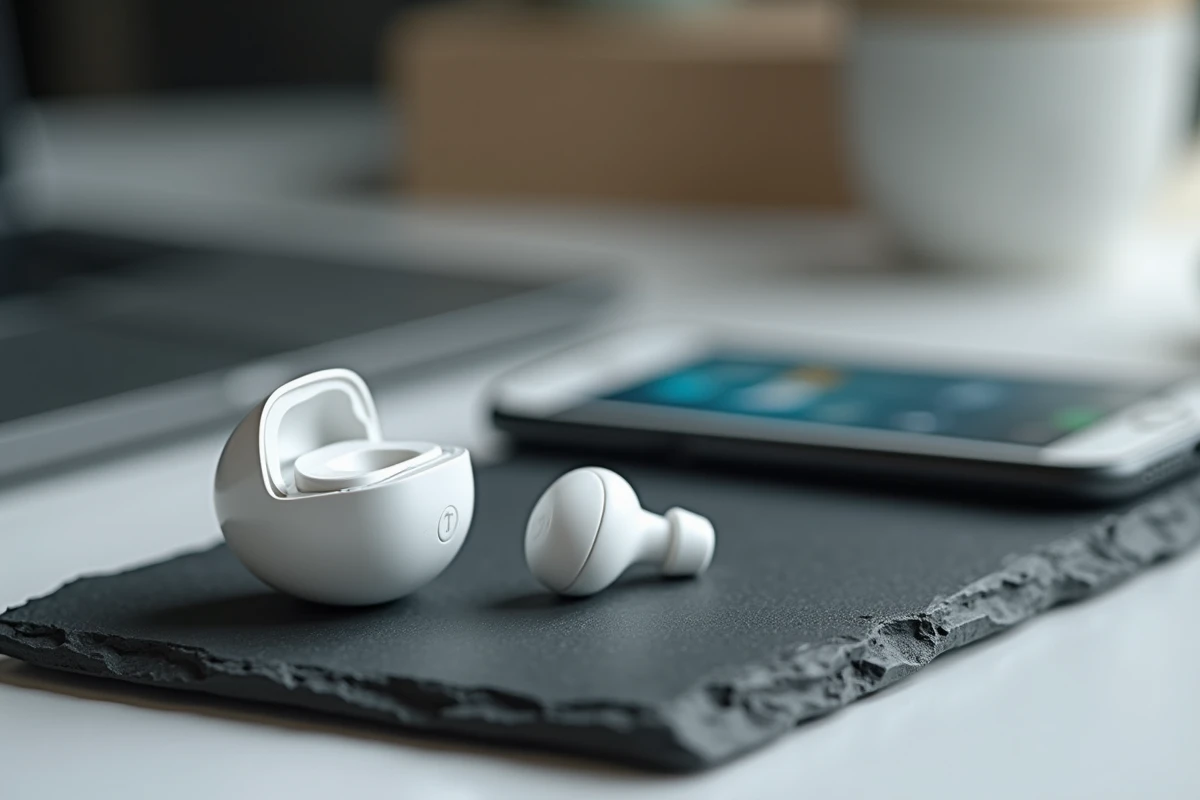
Hearing loops remain useful for users of compatible hearing aids. But they are of no use to those who do not wear them, or whose devices do not have the “T” position. It is estimated that the majority of people affected by hearing loss are not equipped.
What establishments must provide
- A transcription or visual communication device accessible without prior personal equipment (not just a hearing loop)
- Clear signage indicating the availability of these tools from the entrance of the establishment
- Training for reception staff on good communication practices: speaking face-to-face with the interlocutor, articulating without exaggeration, reducing background noise when possible
Regulatory compliance cannot be resolved with a single tool. It requires a combination of technology and human adaptation.
Concrete criteria for choosing an appropriate communication tool
The market offers dozens of applications and devices. They can be classified according to three operational criteria that make a difference on the ground.
Transcription latency
A delay of more than two seconds between speech and text display breaks the natural rhythm of a conversation. The exchange becomes an alternating monologue, not a dialogue. Effective solutions display text with a delay of less than one second.
Management of ambient noise
The ability to isolate the voice of the main speaker in a noisy environment remains the most discriminating factor. Tools that rely on a directional microphone or active background noise filtering produce results significantly superior to those that capture sound via the standard microphone of a smartphone placed on a counter.
User autonomy
A tool that requires the intervention of a third party to be activated will not be used. The hearing-impaired person must be able to start the transcription themselves, on their own device, without complex prior configuration. This criterion eliminates some devices designed for conference rooms that are unsuitable for spontaneous exchanges at the counter.
Live captioning and sign language: two complementary approaches
Real-time written transcription and interpretation in French sign language (LSF) do not address the same audience. Individuals who have become hearing-impaired during their lives most often communicate in spoken and written French. Individuals who are deaf from birth, culturally Deaf, use LSF as their first language.
Offering only captioning does not cover the needs of native LSF speakers. Some solutions now integrate signing avatars generated by artificial intelligence, capable of translating text into sign language. Technology is progressing, but the fluidity and accuracy of facial expressions (grammatical in LSF) remain a point of vigilance.
For an establishment, combining automatic transcription with access to a sign language interpretation service, even remotely, represents the most inclusive configuration. The cost is higher, but the coverage of needs is real.
- Real-time transcription: suitable for short exchanges, counters, medical appointments
- Remote LSF interpretation: suitable for long interviews, complex administrative procedures, meetings
- AI signing avatars: suitable for disseminating standardized information (announcements, safety instructions)
Auditory accessibility is not limited to a binary choice between text and signs. Establishments that make progress on the subject combine several channels, adapted to each exchange situation. The right tool is one that the hearing-impaired person can activate alone, in the real conditions of the conversation.