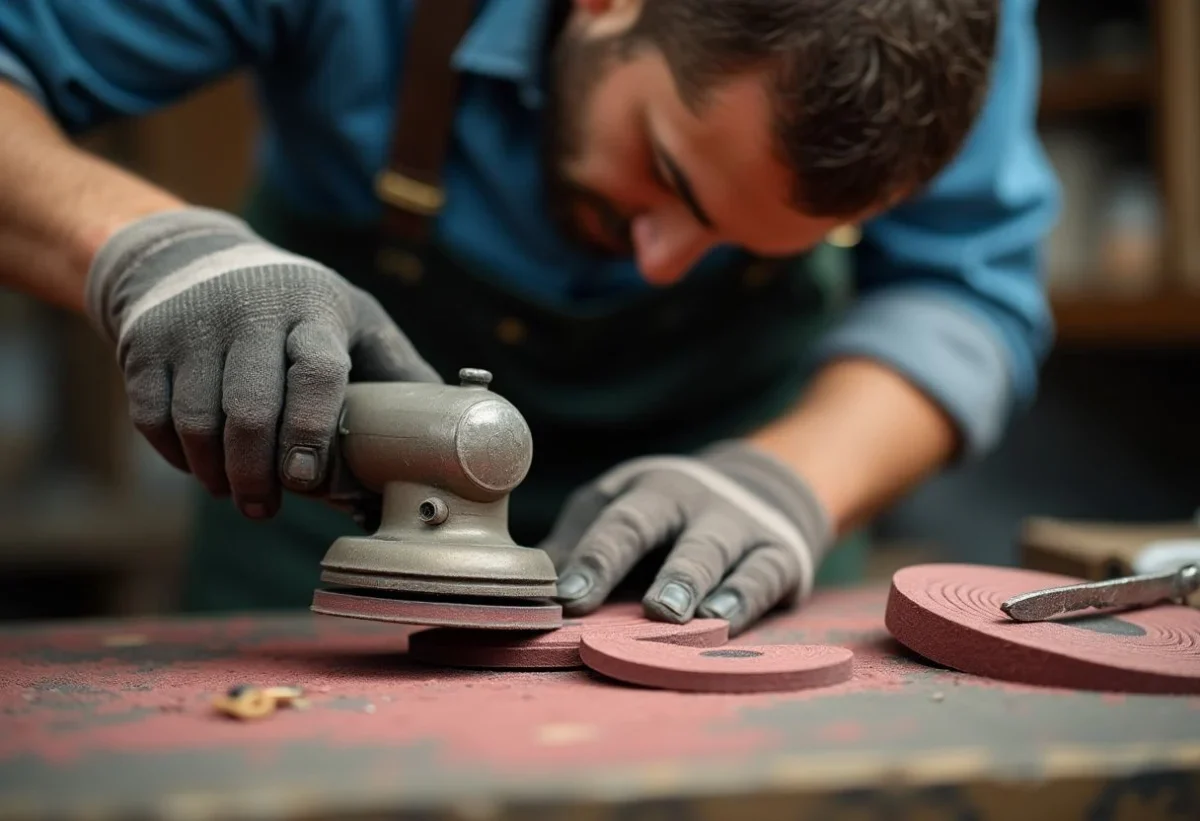
At the heart of woodworking workshops, production factories, and even kitchens, the use of abrasive materials subtly integrates into our lives. These materials, often discreet, are nevertheless of paramount importance for shaping, polishing, and cutting many everyday objects. Between technicality and elegance, the world of abrasives presents itself to us as a realm to explore, rich in discoveries and innovations.
Origins and evolution of abrasive materials
The history of abrasives dates back to ancient times, when simple sand was already used to polish stone. Over the centuries, technological advancements have allowed for the diversification and refinement of these materials.
- Prehistory: The first stone tools, such as flint, were polished using sand or grit, exploiting the natural properties of the materials.
- Middle Ages: The use of natural stones like emery improved the finishing of weapons and tools, providing increased precision.
- Industrial Revolution: The emergence of new industrial processes saw the advent of artificial abrasives, which were more efficient and suited to various industrial needs.
- Modern Era: Current technologies focus on synthetic materials, such as silicon carbide, to offer unmatched performance.
The different types of abrasives and their uses
Abrasives come in several categories, each with its specificities and field of application. The diversity of these materials makes them a versatile tool, essential in many sectors.
We mainly distinguish between natural abrasives, like grit, and synthetic abrasives, such as alumina. The former are often used for delicate polishing work, while the latter are prized in industry for their ability to work with hard materials.
Paper or cloth abrasives are commonly used in woodworking, allowing for precise and effective sanding. Coarser abrasives, on the other hand, are favored in metallurgy for shaping and cutting metal parts.
The impact of technological advancements on abrasives
Technical progress has transformed the abrasive industry, offering increasingly efficient solutions tailored to the specific needs of users.
- Nanotechnology: The integration of nanotechnology into abrasive materials has significantly improved their effectiveness by reducing grain size for enhanced precision.
- Research and development: Ongoing efforts in R&D have led to the creation of high-performance abrasives capable of withstanding the most extreme conditions, such as use on ultra-resistant materials.
- Durability: Innovations have also enabled the development of more durable materials, thereby reducing replacement frequency and associated costs.
- Customization: Modern technologies offer the possibility to design custom abrasives specifically meeting client needs.
The essential role of abrasives in industry
Abrasives play a fundamental role in many industrial sectors, where they are used for a multitude of tasks ranging from finishing to cutting.
In the automotive sector, for example, abrasives are essential for sanding car bodies, allowing for a smooth surface before painting. In metallurgy, they are used to prepare parts before assembly, ensuring perfect and durable welds.
In electronics, abrasives are employed to polish integrated circuits, thus ensuring optimal contact between components. The construction field is no exception, using these materials to polish concrete or stone surfaces.
Choosing the right abrasive is therefore crucial to ensure the quality of the finished product.