
In France, the hardness of water varies significantly from one municipality to another, and water that is too hard accelerates the scaling of pipes, water heater elements, and household appliances. Installing a water softener helps limit these deposits by replacing calcium and magnesium ions with sodium ions using an ion exchange resin. The operation remains accessible as long as a few often underestimated technical and regulatory constraints are respected.
Setting the residual hardness: what the regulations require
The temptation is strong to set the softener to eliminate all the limescale. This is a mistake. The decree of January 11, 2007 sets a minimum quality reference of 15 °f for distribution. Water that is too soft becomes aggressive for metal pipes, promoting corrosion and leaching of metals such as lead or copper.
Therefore, the device’s setting must maintain sufficient residual hardness. In practical terms, this means that the softener valve is adjusted based on the measured inlet hardness using a TH kit, aiming for an output around 15 to 20 °f. First and foremost, one must know the hardness of their water: this information is found on the water bill or on the ARS website for your department.
This setting is not just a formality. Softened water increases sodium content, which has direct consequences for food use. Anses recommends keeping a point of untreated cold water for drinking, cooking, and preparing baby bottles. Planning a bypass on the cold water supply to the kitchen is therefore an integral part of the project, not just an optional addition.
Those considering installing a water softener at home should anticipate this constraint right from the choice of location, to simplify the connection of the food bypass.
Location and connection: the real technical constraints

The softener connects to the main water supply, upstream of the distribution to the various points in the home. The location must meet several simultaneous conditions, and this is often where projects become complicated.
- The water pressure must be within a range compatible with the device, generally between 1.5 and 6 bars. A pressure that is too high requires a pressure reducer upstream.
- A wastewater drain must be accessible nearby, as the regeneration cycles discharge brine. The ARS also recommends installing a backflow prevention device to prevent any backflow of softened water into the public network.
- The area must be dry, ventilated, and protected from frost. A garage, laundry room, or technical room is suitable, provided the temperature does not drop below zero.
- The available space must allow access to the salt tank for reloading and maintenance, not to mention the necessary space for a possible bypass to the kitchen.
Regarding discharge waters, field returns vary on compatibility with septic tanks. Some manufacturers allow it, while others advise against it due to the salinity that can disrupt the bacterial functioning of the tank. If your home is not connected to the sewer system, check this point with the manufacturer and the local sanitation service before committing.
Softener for the entire network or only for hot water
Most domestic installations treat the entire network. This configuration simplifies the connection, but it is not always the most relevant. Limiting softening to the hot water circuit reduces salt consumption, decreases brine discharge, and avoids the issue of sodium in drinking water.
The ARS recommends in some cases reserving the softener for the hot sanitary water circuit. Limescale indeed causes its most costly damage in circuits where water is heated: tanks, boilers, washing machines, dishwashers. Cold water used at kitchen and bathroom taps poses fewer scaling problems.
However, this configuration requires a more complex connection, as it is necessary to intervene upstream of the hot water tank and not on the general supply. For an existing home, this may involve additional plumbing work.
Maintenance and common pitfalls after commissioning
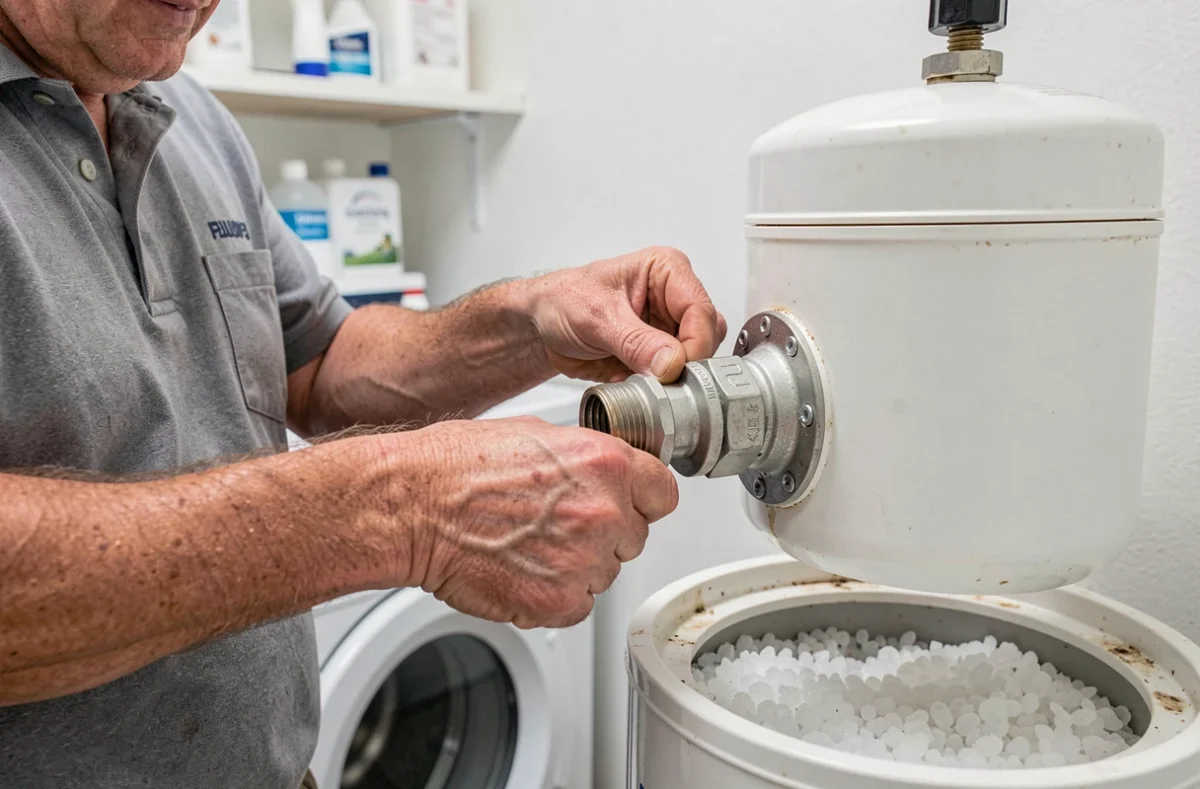
A poorly maintained softener can become a health issue. The first reflex of many users is to check the salt level in the tank. This is insufficient. An apparently full tank may contain a salt bridge, a hard crust on the surface that prevents brine from forming properly below. Regeneration then occurs without salt, and the water is no longer softened.
To detect a salt bridge, simply gently push the surface with a handle. If it resists and forms a block, it needs to be broken up and the salt stirred. A monthly check of the output hardness with TH strips remains the most reliable method to verify that the device is functioning properly.
Another frequently overlooked situation is the recommissioning after a long absence. After more than three weeks of inactivity, a double regeneration is recommended before using the water. All draw-off points must then be flushed, and the output hardness checked. Stagnant water in the resin can promote bacterial growth, a risk that most manufacturers’ manuals mention without emphasizing it.
The salt used must be specific regenerating salt, in tablets or crystals designed for softeners. Table salt or de-icing salt contains impurities that clog the resin and reduce its lifespan.
Installing a domestic softener remains a moderate plumbing project, achievable in a few hours for a equipped DIYer. The points of vigilance lie less in the connection itself than in the initial setting, the choice of configuration (complete network or hot water only), and the regular monitoring of the actual operation of the device.