
Parental mental load, permeability between professional and personal life, proliferation of screens: the factors weighing on family life have intensified in recent years. Rather than listing generic recipes, this article measures the gaps between families that implement concrete tools for daily management and those that improvise, to identify what truly makes a difference.
Remote work and family life: measurable but contradictory effects
The widespread adoption of remote work since 2020 has profoundly changed family organization. DARES showed in 2023 that the regular practice of remote work in France is significantly higher than before 2020. Parents are more present at home, which could theoretically promote interactions with children.
However, this increased presence is accompanied by permeability between professional and personal spheres, which DREES has documented in its post-Covid studies. The difficulty in “disconnecting” generates emotional fatigue that directly impacts the quality of family interactions. The parent is physically present but mentally absorbed by a work screen.
Researchers in labor sciences have observed that families who establish fixed time slots for parental availability (as opposed to a “floating” availability throughout the day) report fewer conflicts related to attention. This point is regularly found in the family section on Vraiment Sympa, where family planning is approached from a practical angle.
Parental mental load: what recent surveys reveal
The UNAF Family Life Observatory highlighted in 2023 that parents report more difficulties in “balancing everything” than in 2018. The feeling of exhaustion is significantly increasing among mothers. DREES confirms this trend with a deterioration in the psychological well-being of parents linked to the combination of work, school monitoring, and domestic management.
| Factor | Before 2020 | After 2020 |
|---|---|---|
| Parental exhaustion feeling | Reported by a minority of parents | Significantly increased, especially among mothers (UNAF 2023) |
| Remote work practice | Marginal | Significantly higher (DARES 2023) |
| Conflicts related to task distribution | Present but stable | More frequent, correlated with professional/personal permeability (DREES) |
| Time spent with family | Concentrated on evenings and weekends | More spread out but perceived quality lower |
This table highlights a paradox: more time spent together does not mean better relational quality. The increase in shared time under the same roof, when not structured, can even increase tensions.
Distribution of domestic and educational tasks
The mental load is not limited to the volume of tasks. It includes invisible planning: thinking about medical appointments, anticipating meals for the week, managing extracurricular activities. This dimension of family management remains predominantly carried by one parent in most French households.
Families that use shared planning tools (visible family calendar, collaborative shopping list, explicit distribution of responsibilities) report a notable decrease in daily frictions. The shift from implicit organization to explicit organization constitutes a concrete lever.
Family activities and child autonomy development
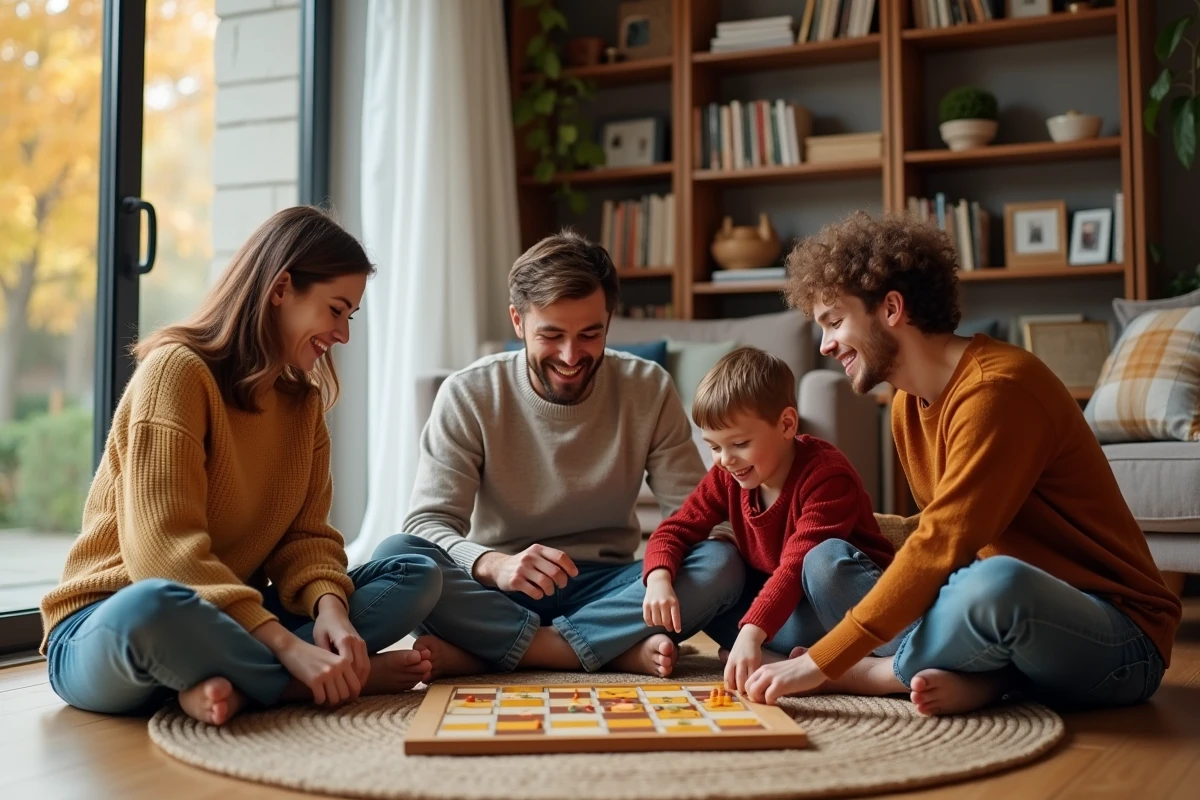
Shared family games and activities do not serve only to “have a good time.” They contribute to the child’s autonomy development and the building of social skills. Conversely, an excess of directed activities can produce the opposite effect by overloading the family schedule.
Three types of activities stand out for their impact on family dynamics:
- Cooperative games (non-competitive board games, cooking together, DIY projects) enhance communication and collective problem-solving, even among children as young as preschool.
- Outdoor activities without a specific goal (walking, gardening, free exploration) promote child autonomy and reduce parental stress related to managing a structured program.
- Short family rituals (shared meals without screens, bedtime reading, roundtable of “moments of the day”) create a regularity that secures the child without burdening the schedule.

Screens and family time: a decision to make
The issue of screens at home cannot be resolved by a total ban or complete laissez-faire. Families that define screen-free zones and times (meals, the first hour after school) report an improvement in the quality of exchanges. The rule works better when it also applies to parents, which ties back to the issue of professional disconnection mentioned earlier.
Educational models and daily conflict management
Educational models vary considerably from one family to another, and none offer an absolute guarantee. However, data converge on one point: consistency between the two parents matters more than the chosen model. A child who receives contradictory messages about household rules is more likely to develop oppositional behaviors.
Managing conflicts between children or between parents and children benefits from following a few simple principles:
- Naming the emotion before seeking a solution (“you are angry because…”) reduces escalation in most situations.
- Postponing the discussion when the emotional level is too high, rather than forcing an immediate resolution.
- Returning to the conflict when emotions have cooled to establish a clear rule, understandable by the child according to their age.
These approaches do not belong to a specific educational trend. They reflect a shared observation among education professionals: emotional regulation is learned, and the family remains the primary place for this learning.
The factor that stands out most clearly from recent surveys is the gap between intention and organization. Families that report being the most fulfilled are not those with more time or resources, but those that have clarified their operating rules and adjust them regularly. Family life is built less on grand principles than on repeated, visible, and shared micro-decisions.